
What is the Difference Between 2-Roll, 3-Roll, and 4-Roll Squeeze Stands, and How Does a Hybrid All-in-One System Reduce CapEx?
In a welded tube mill production line, the Squeeze Stand is a core component within the welding section. Its function is to support the formed tube and apply pressure so that the heated edges of the steel strip are in the optimal condition for welding together.
Today, Squeeze Stands come in various configurations, including 2-Roll, 3-Roll, and 4-Roll designs. However, a common misconception is that "more rolls mean better performance or suitability for every production line," which is not always true. The decision must be evaluated alongside other factors such as tube size and thickness, material type, welding system, line speed, available installation space, and the limitations of existing machinery.
For factories planning to expand their production lines or needing to accommodate a wide variety of tube specifications, investing in separate Squeeze Stands for each type can lead to high capital expenditures (CapEx) and waste valuable floor space. The All-in-One Hybrid Squeeze Stand system has thus emerged as an attractive alternative. In this article, we will take a deep dive into the pros and cons of each system.
What is the Role of a Squeeze Stand in a Tube Mill?
Before the steel strip enters the welding section, it must pass through the forming section, where multiple roll passes gradually shape the strip into an open-seam tube. After that, the Fin Pass controls the shape and prepares the strip edges for welding.
Upon entering the welding section, the Squeeze Stand works in conjunction with other equipment, such as the seam guide, welding coil, or heating system. Its primary functions include:
Stabilizing and supporting the tube's shape as it enters the welding point.
Controlling the position of the strip edges to ensure they are correctly aligned.
Applying pressure to force the molten strip edges to fuse together completely.
Maintaining the relationship and balance between the weld seam, welding point, and the roll sets.
Guiding the tube toward subsequent processes like bead scarfing, cooling, and the sizing section.
The Squeeze Stand is not the sole variable determining the finished tube's size or quality. High-quality tubes require synchronized operations from the Forming Pass and Fin Pass all the way to the Sizing section.

An example of a Roll Stand structure and roll tooling in CHP's metal forming process, used to illustrate general stand components.
Image Source: CHP Rolling Engineering
Why Does the Number of Rolls Affect the Production Process?
The number of rolls directly impacts the "number of contact points around the tube," "direction of pressure distribution," "shape-supporting efficiency," and the "complexity of machine setup" for the operators.
However, machines from different manufacturers may feature varying contact angles, adjustment systems, or roll profiles, even if they are both labeled as 2-Roll or 3-Roll systems. Therefore, before making a purchase decision, it is essential to review the drawings, specifications, and the actual production capacity of the machine.
Deep Dive: 2-Roll Squeeze Stand
This system utilizes two rolls working together to support the tube and apply pressure. The rolls can be positioned as a left-right pair or a top-bottom pair, depending on the manufacturer's design.
Key Considerations:
Provides 2 main contact points around the tube.
Features a simple structure with fewer adjustment mechanisms than other systems, making it easy to maintain.
Roll positioning must be precisely aligned with the center line and weld seam.
The roll profile plays a crucial role in supporting the tube and transferring pressure.
The supported tube size range depends heavily on the specific design of the stand and tooling.
Recommendation: Do not jump to the conclusion that a 2-Roll system is only suitable for small or thin tubes. There are heavy-duty 2-Roll machines on the market designed for large tubes. The choice should be based on the machine's actual capacity.
Deep Dive: 3-Roll Squeeze Stand
This system uses three rolls to distribute contact points around the tube. The most popular industrial design is a "Y" configuration, though the direction of applied pressure may vary by brand.
Key Considerations:
Provides 3 contact points around the tube.
Offers excellent pressure distribution and tube support across multiple points.
Operators must carefully manage the symmetry of all three rolls.
Requires expertise during setup, as misaligned roll gaps or center lines can negatively impact weld seam quality.
Some models allow for independent adjustment of each roll, while others adjust them simultaneously.
Caution: More adjustment points mean a higher risk of mechanical backlash or mispositioned rolls if components wear out. Using a setup plug or reference tool during machine configuration helps minimize errors compared to measuring rim gaps by eye.
Deep Dive: 4-Roll Squeeze Stand
This system employs four rolls to create multiple support contact points. The rolls can be positioned on the top, bottom, and sides to apply pressure and support the tube shape from various directions.
Key Considerations:
Provides the highest number of contact and control points around the tube, allowing for precise shape control.
Distributes pressure and supports the tube from multiple angles, making it ideal for high-stability applications.
Setup requires extreme precision to ensure all four rolls work in perfect synchronization.
Features more mechanical components (bearings, shafts, adjustment systems), leading to increased maintenance time and costs.
Requires more installation space compared to other systems; extra room must be allocated for tooling changeovers.
Why Invest in a Hybrid Squeeze Stand?
Investing in separate Squeeze Stands for different tube specifications can result in unnecessarily high capital expenditures (CapEx) and lost floor space. The Hybrid Squeeze Stand (All-in-One system) was developed to provide maximum flexibility. A single machine can change its configuration to operate as a 2-Roll, 3-Roll, or 4-Roll system depending on the specific job requirements. This allows factories to expand their product ranges without having to purchase entirely new stands.
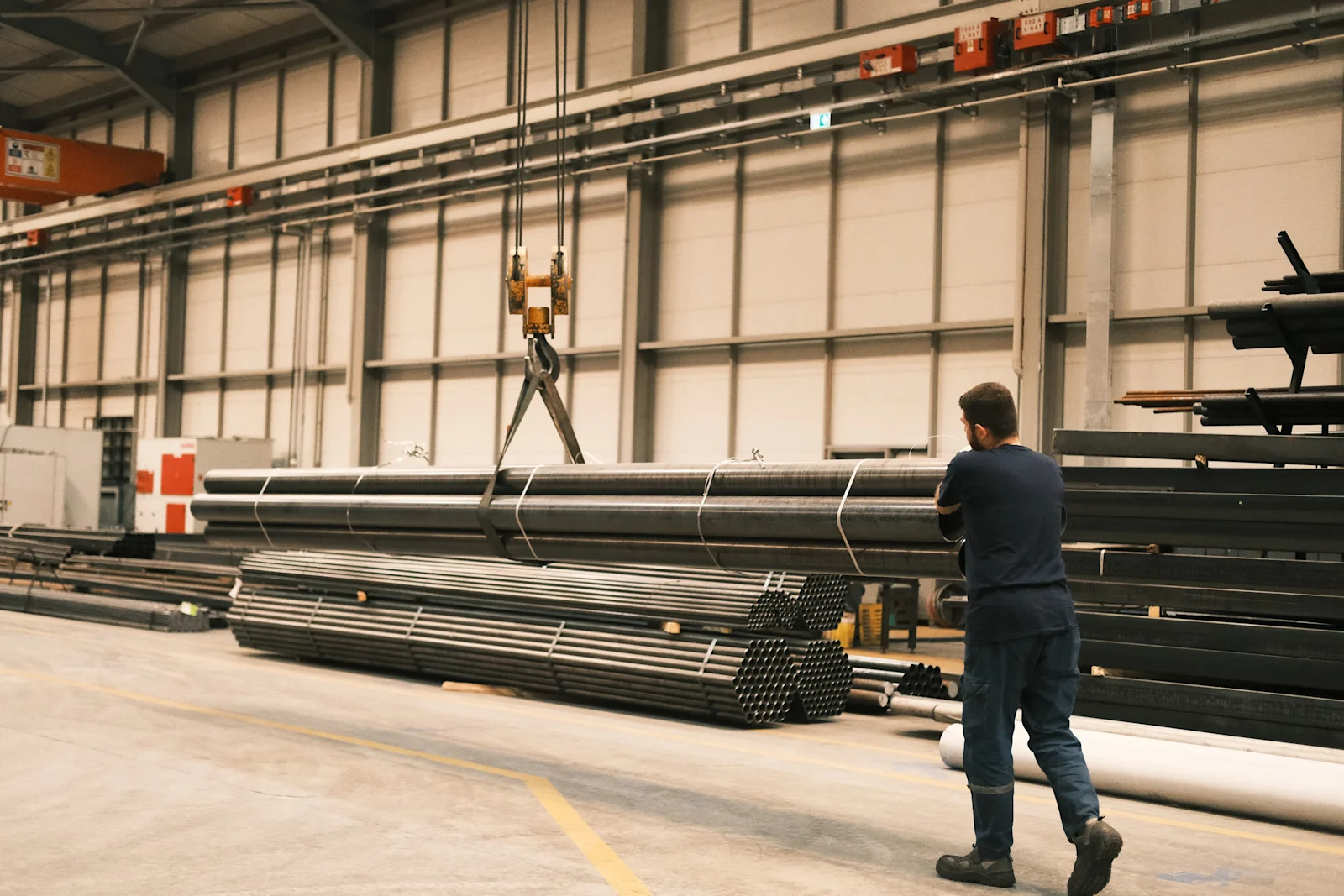
An example of steel tube management and operational space within a factory, factors that should be considered alongside machine costs and production line layouts. (Note: This image is not a CHP project.) Image Source: Cemrecan Yurtman / Pexels — Pexels License
If you are looking to upgrade your tube production line to boost your competitive edge, CHP is ready to provide consultation and design Made-to-Order tube mill machinery. We offer Hybrid Squeeze Stand solutions tailored to your budget and available workspace for maximum cost-effectiveness. Contact our engineering team today